
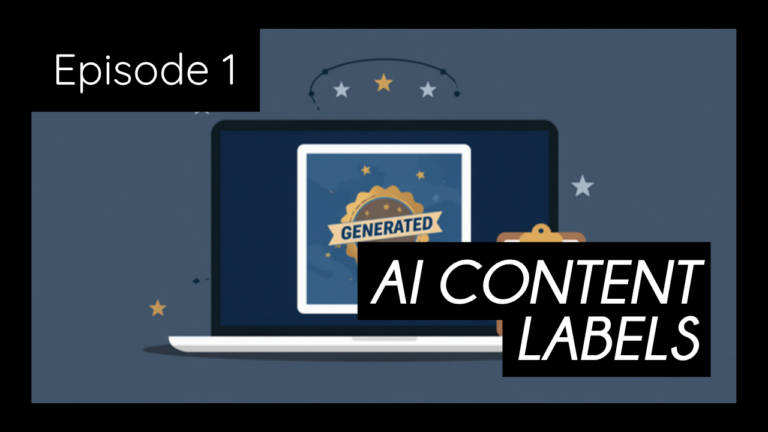
If your marketing team uses AI to generate images, video, voiceovers, or chatbot responses, a rule that took effect on August 2, 2026 now applies to you, even if your business is nowhere near Europe. Under Article 50 of the EU AI Act, AI-generated content that could pass as real must carry a clear, understandable label disclosing that it was AI-made. For marketing teams that have leaned into AI-generated visuals and synthetic voices over the past two years, this is one of the biggest compliance shifts of 2026.
What Actually Needs a Label
The rule targets content designed to look or sound authentic. That includes:
- Photorealistic AI media: images, video, or audio that “closely resemble reality,” including AI-generated models in ads, synthetic voiceovers in commercials, and fabricated settings or backgrounds
- Significant manipulations: deepfakes, or edits that meaningfully alter context, proportions, or the apparent state of a person or scene
- AI chatbots: automated customer service tools must clearly disclose to visitors that they are interacting with AI, visibly on the website or app
What Is Exempt
Not everything AI-touched needs a label. The rule carves out normal, everyday uses of AI in a marketing workflow, including:
- Text that has gone through human editorial review and verification before publishing
- Basic photo corrections, like color adjustment, sharpening, or cropping
- Abstract design elements such as logos or vector graphics
- AI used purely for research, outlining, proofreading, or early drafts, rather than final published output
Why This Is a 2026 Marketing Trend, Not Just a Legal Footnote
This regulation is reshaping how brands think about AI in creative production, not just how they think about legal risk. Marketing teams that built entire content pipelines around AI image and video generation are now having to add a disclosure step before anything ships, which means rethinking approval workflows, agency contracts, and even caption templates. Expect “content created using AI tools” or similar plain-language disclosures to become as common in social captions and product pages as cookie banners became a decade ago.
The Cost of Getting It Wrong
Non-compliance is not a minor risk. Penalties can reach up to €15 million or 3% of a company’s annual global turnover, whichever is higher. The rule also applies across a company’s external partners and vendors, meaning a brand can be exposed by an agency or contractor’s undisclosed AI use, not just its own.
A Practical Compliance Checklist for Marketers
- Audit every AI tool currently used internally and by outside agencies or freelancers
- Separate “AI-generated” content (built primarily by AI) from “AI-assisted” content (human-made, AI-supported)
- Require human review and sign-off before anything AI-generated or AI-manipulated is published
- Assign one person or team the authority to approve labeling decisions
- Standardize your label language and placement across every channel, ads, social, email, and web
- Train your team and vendors on what counts as a deepfake or significant manipulation under the rule
Frequently Asked Questions
When did the EU AI Act content labeling rule take effect?
The transparency obligations under Article 50 of the EU AI Act took effect on August 2, 2026.
Does this apply to businesses outside the EU?
Yes, if your marketing content reaches EU audiences or customers. Many brands are choosing to apply one consistent labeling standard globally rather than maintaining separate versions for different regions.
Do I need to label an AI-written blog post?
Not necessarily. Text that has been reviewed, edited, and verified by a human before publishing generally falls outside the labeling requirement, as does using AI for outlines, research, or proofreading.
What are the penalties for non-compliance?
Fines can reach up to €15 million or 3% of a company’s annual global turnover, whichever amount is higher, and liability extends to a brand’s external partners and vendors.
Building an AI content workflow that is both efficient and compliant does not have to slow your team down. Visuapex Creatives can help you set up labeling standards and review steps that fit naturally into your existing content process.